

The Spark. I did not expect to feel it again. The last time I felt it was in 2011, when I joined Zendesk and sensed I was stepping into something much bigger than a job. The spark is created by a rare mix of timing, people, product, and cultural shift. Back then it was a revolutionary way of reinventing customer support software. This time it’s something much more fundamental.
The first Spark
The last 13 years I was my own boss and had all the freedom in the world. Why would I leave that behind to work for someone again?
Because of that spark. Some companies have it, during a specific window of time. It can easily fade, but as long as it’s there I love to ride its wave. Back in 2011 I randomly filled in an online application form, just for fun. I didn’t even know what Zendesk was. All I did was google “Coolest Job of the World.” I wasn’t looking for a job.
“Hi, this is Maxime from Zendesk, I’m calling you because of your application,” echoed through my old Nokia 2710 the morning after, when I woke up on the floor, still running a fever from malaria. And there it was. The spark, in Maxime’s voice. Something between the words. Something intuitive. A couple of weeks later I’d learn how badly he had wanted to work at Zendesk that he showed up unannounced at the San Francisco office and literally cried when they told him he didn’t have a US work visa. They offered him a support role in London, and a few weeks later he was leading the enablement team. Zendesk did not need to chase people. People wanted in.
Customers wanted pictures with us after bootcamps. There was something bigger than software happening. And with Wispr I feel it even more strongly.
The life between two sparks
After Zendesk grew from 50 to 2,000 people, I built my own company. Left London to open an office in Berlin, hired my first two employees. Then one day I sat down and realized this was all too predictable. It felt like watching a movie I already knew the ending of.
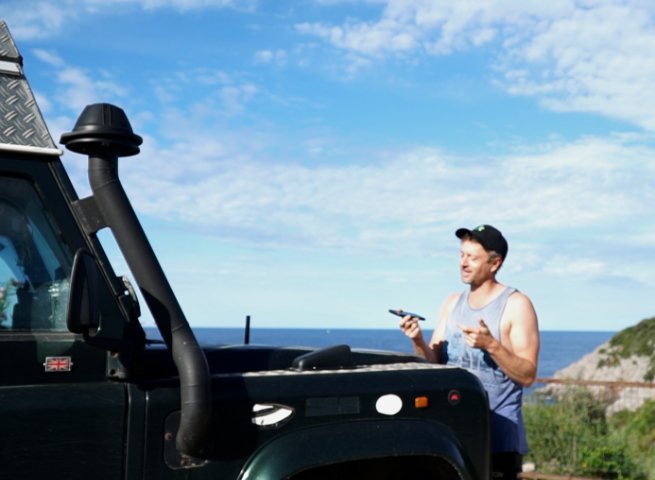
I opened WhatsApp and typed to a friend: “What should I do with my life?” One minute later he replied: “Buy this Land Rover.” He sent a link to a message board where a converted Land Rover Defender was for sale near Buenos Aires. What the heck would I do with a Land Rover, I thought. After a quick toilet break, I had my answer: buy it, rent the company out, and drive from Buenos Aires to Colombia. Nothing too foreseeable. An actual challenge.
It was serendipity again. The same force that had dropped me at Zendesk’s door was now steering me toward a Land Rover Defender in Argentina.
A month later, we were running Helpando from the most impossible places: the Land Rover itself, Peruvian desert internet cafes, jungle lodges, mountain tops, petrol stations. We drove 12,000 kilometers, filmed a video documentary, interviewed entrepreneurs, and showed up for talk shows and press appearances ourselves. The Land Rover broke down constantly. It was challenging in ways that were good for me.
We had to compress 8 to 10 hour workdays into four. When your back hurts, your internet is unreliable, and your office is the passenger seat of a Land Rover Defender, you get very good at one specific question:
What are the repetitive tasks we do on a daily basis that steal us time and create friction?
Especially while driving, when I couldn’t type, I would think through that question out loud and speak the answer into a voice note. Back at the computer I’d build custom shortcuts in AlfredApp and share them via Dropbox with the team.
Sending a Calendly link to a client? One keystroke. Logging into a specific tmux session via terminal? “CMD-Space login skyscanner ENTER.” Passport details? One keystroke. Calendar event for tomorrow at 5pm? Type “cal tmr 5pm meeting with richard” and it lands in the calendar.
After a year in South America, we had more than 500 custom shortcuts configured. I still use them today.
But things were still not ideal:
- The shortcuts only lived on my Mac, not my phone
- I still had to reach for the keyboard to trigger them, which wasn’t always easy while waiting at red lights with the laptop on the passenger seat
- I could send voice messages while driving, but recipients often found them annoying
Not a single week passed where I didn’t fantasize about a small gadget near my ear, a button I could press to utter a voice command that would trigger an action on my computer or phone. At the time this felt like science fiction. But the problem was obvious to me.
My thoughts were not the bottleneck.
My fingers were.
My screen was.
The interface was.
I did not want another productivity app. I did not want another dashboard, another inbox, another system to maintain. I wanted to speak my intention into the machine and have it understand what I meant. Not just transcribe my words. Understand the task.
For years I kept running into the same wall. I could think faster than I could type. I could speak more naturally than I could structure. Ideas arrived while walking, driving, cooking, showering, jogging. But the moment I had to sit down, open the laptop, find the right app, place the cursor in the right field, and type it all out, something had already been lost.
Why Wispr hit me so hard
It was December 20, 2025. I was in a coffee place in Playa del Carmen, Mexico, working away on my keyboard, when someone who had spotted my 4in7out.com sticker on a street in Berlin sent me a WhatsApp message saying I should try Wispr Flow. Pretty random. The minute I finished the tutorial, I was hooked. The first thought I had was: I want to work for this company.
It felt like a serious attempt to build the layer I had been fantasizing about since those Land Rover days. A way to remove the unnecessary distance between what appears in the mind and what appears in the world.
I started working my way through every interview Tanay, the CEO and co-founder, had ever given. In one podcast he said:
The reason we started the company in the first place was that I hate people looking down on their phones all day long. And to me, if we wanted to get people off of that, it was clear it’s not gonna be a screen time app that’s going to do it. It’s going to be a fundamental transformation of what personal computing looks like.
And ultimately this is why I join Wispr. Not to work more efficiently, not to get more done. But because I believe we as ah umano…
So why am I actually joining?
I’m joining Wispr as their European evangelist, starting with Germany, Benelux, and the Nordics. These are markets with specific friction that a US-built product almost never accounts for out of the box: mixed-language workdays, documents that switch between German and English mid-sentence, teams operating across four time zones and three keyboard layouts. On any given afternoon I’m working in German, English, Spanish, and Portuguese. The interface bottleneck is not abstract here. It is daily and it is multilingual.
But the role matters less than the reason.
I am not joining to work more efficiently. I am not joining to get more done. I am joining because I think we have been bending ourselves around the machine for long enough. The keyboard was designed for typists. The screen was designed for people sitting still. Neither was designed for how the human mind actually works: in motion, in conversation, half-formed and fast.
We were not born with a keyboard. We were born with vocal cords.
But this goes deeper than efficiency. I keep coming back to the sticker. Someone saw it on a wall in Berlin. Months later, from Mexico, they messaged me. And that random message is the reason I am writing this now. That is serendipity working exactly as it always has in my life: through presence, through noticing, through being in the world rather than inside a screen.
I became Germany’s freediving record holder because I turned a corner in Mexico and saw a sign on a wall reading “Try Freediving”. I ended up at Zendesk because I typed something random into Google one afternoon while in a Malaria delirium in Congo and followed a feeling. I bought a Land Rover Defender in Argentina because a friend answered a WhatsApp message in under a minute and I was paying attention. None of these things were planned. All of them required me to be present and open enough to notice.
And I think that is what has been quietly eroding – Serendipity. The constant bending toward a screen, the cursor-hunting, the app-switching, the reformatting of a thought so it fits into a text field — it is low-grade friction that compounds across a day until the day itself has passed and you were mostly looking down.
And when you are looking down, the algorithm is already waiting. It does not need to be clever. It just needs you to be on the screen. The scroll is one thumb movement away. The notification is already in the corner.
Voice changes that equation. If your work no longer requires you to stare at a text field, the algorithm loses its entry point. You can finish the email while looking up. You send the message and you are still in the room.
When I imagine what changes if the interface finally gets out of the way — not faster typing, not better autocomplete, but genuinely speaking your intention and having it understood — I don’t think about output first. I think about what comes back. The cognitive load that dissolves. The hours that stop disappearing into the gap between thought and screen. The looking up. The walking. The turning of corners. The human connections.
The sticker on the Berlin street only worked because someone looked up and saw it.
That is the deeper reason I am joining Wispr. Not to move faster. To be more present. And to help build the thing that gives other people that space back too.
Come Flow With Me
Update: July 31, 20206 – After my onboarding in San Francisco. Wispr and I figured out that the best investment of my time is not only speaking at conferences, but also doing a road trip for Wispr. I’m currently sitting in an old 1975 Volkswagen T2 in Denmark, and I’m going through the Nordics, meeting founders, influencers, and other people talking about what stays human in times of AI. You can follow the project right here – comeflowwithme.com