

I feel like I’ve had a great career.
I was one of the first employees at Zendesk. I built my own tech startup and ran it from a Land Rover Defender while driving across continents. And recently, I invented my dream job at Wispr Flow in San Francisco.
I never had a CV. I never sent a cover letter.
At the same time, I meet people who are struggling to find a job, sending hundreds of CVs and getting only rejections. So I felt like writing about how I find and create jobs for myself. Maybe there is some inspiration in it.
Let me start with a story from high school.
When I was 15, a job counselor whom the teacher introduced as “Herr Krause” came to our classroom.
“If you want to become employable,” Mr. Krause told us, “you need good grades, consistency in your decisions, and no gaps in your CV.”
The German word he used for employable was einstellbar.
It means employable, yes.
But literally, it also means adjustable. Like a machine. Like a radio. Like something you can tune until it does what someone else wants.
I was 15, listening to Guns N’ Roses and Nirvana, and here was a guy telling me I had to become an adjustable person so I could find a job?
No way.
Thirty years later, I still never really had a CV. I wasn’t consistent in my decision-making. And my CV, if I had one, would have been one giant gap.
So how did I find jobs?
The short answer is: by doing it my way.
The long answer is this:
Instead of sending out hundreds of applications, aim for the one dream job you truly want. Then show them that you want it, using a combination of a video CV and an innovative way of getting that video in front of the person who matters.
In other words:
Don’t fish with a giant net and hope some random fish gets trapped.
Pick the fish you actually want.
Study the water. Learn what it bites on. Then hand-tie the bait so specifically that when it sees it, it feels like:
“This was made for me.”
That’s what a great video CV does when it reaches the right person in the right way.
Let me show you what I mean. Let’s go from the present to the past.
Landing a Job at Wispr
Three weeks ago, I was standing at SeaSpace in Montenegro, my freediving retreat center and coworking space, which I built a couple of years ago.
Bookings for 2026 were lower than I had hoped. Competition had increased, AI was changing the market, and even my startup Helpando.it seemed to be getting fewer projects.
So I thought: maybe I should look for a job.
Then I asked myself a question:
What would be the perfect job for me? What kind of job would I almost pay to do?
The answer was clear: becoming an evangelist for Wispr Flow.
So I recorded this video:
My plan was to send it to the CEO, Tanay.
But Tanay is the CEO and co-founder of a $700 million AI startup. He is probably very busy and unlikely to open emails from unknown senders. Also, I didn’t have his email address.
The Strategy
The strategy is simple:
- Record a video and start by saying, “Hi [Name of the person you are talking to].” In this case: “Hi Tanay.”
- Identify people who work at the company.
- Send the video to them on LinkedIn.
- If nobody replies after a week, find their private Instagram accounts and send it there.
- If nobody replies after another week, try Facebook, Twitter, or wherever else you can reach them.
- Still no reply? Generate a QR code that links to your video. Print it and stick it to their entrance door with a funny message.
This approach has worked surprisingly well for me over the past 20 years.
It helped me get sponsorships from brands like Red Bull, Just Music, and Apple resellers. It helped me find jobs, get invited to interviews, land podcast appearances, and speak at events around the world.
With Wispr, I didn’t have to go all the way to step 6.
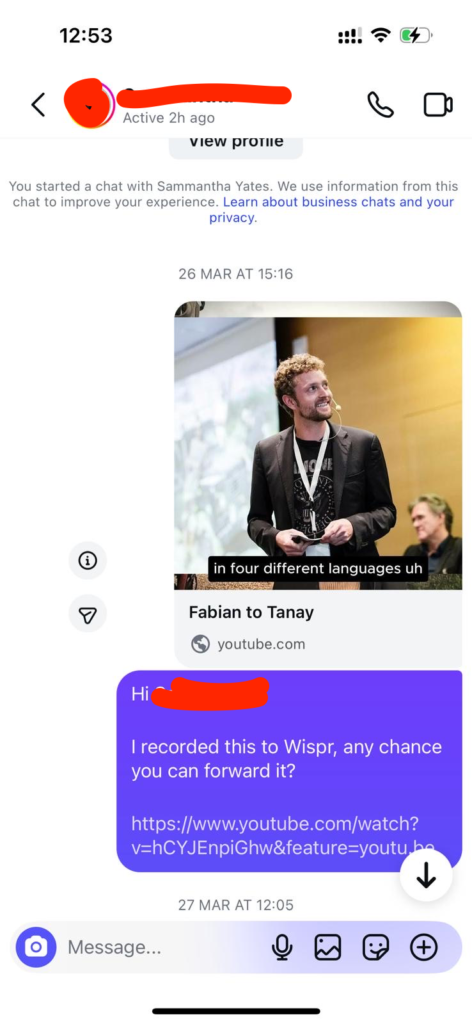
After I received no replies on LinkedIn, I found the private Instagram account of a Wispr employee and sent her the video.
Here is a screenshot from the messages:
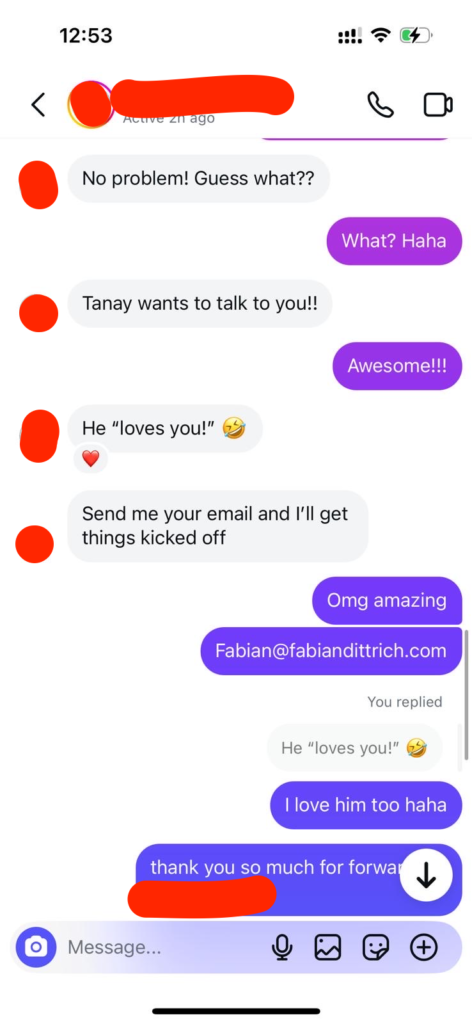
The answer came about a week later:
I was super excited.
A day later, a call with Wispr CEO Tanay was scheduled.
Why Personal Beats Generic
Now comes the important part.
As a CEO and founder myself, I receive CVs and cover letters all the time. And 99% of them are boring as hell.
Why?
Because they contain nothing personal.
Most of them simply say:
“I would like to apply for a job at your company. Here is my CV.”
Next.
But if I receive a cover letter or a LinkedIn message that shows the person invested even a little bit of time to personalize it, I immediately get interested.
If someone writes:
“Hey, I really loved how you and your first employees ran your company from a Land Rover Defender while driving from Uruguay to Colombia,”
then I know they have done some research. I know they understand at least a little bit of what I stand for.
Do the Research
Invest a couple of hours and write down direct quotes from the founders or the person you want to reach.
Find out what drives them. What made them create the product? What made them found the company? What problem are they trying to solve?
Then use that in your approach.
When the person watches your video or reads your message, they should feel that you didn’t just apply randomly. They should feel that you took the time to understand who they are, what they care about, and what they are trying to build.
So how did I apply this to my meeting with Tanay?
I had already shown my passion through the video. Now I had to put some action behind my words.
Wispr Flow is a voice-first assistant that writes messages for you in multiple languages, improves your grammar and punctuation, and feels like talking to a friend.
My idea was to watch interviews with Tanay, understand his vision for Wispr, and then play that vision back to him in six different languages during the call.
I would speak sentences into ChatGPT in Hindi, Portuguese, French, English, Spanish, and German, and ChatGPT would translate them back to Tanay in English.
The call was amazing.
Shortly after, Tanay connected me to the CMO and scheduled another call with him.
I did the same demo for the CMO. Soon after, I received an email that started like this:
“Really enjoyed meeting. I don’t think I’ve ever started a meeting with a multilingual skit that plays back some of my own perspective. It’s made every meeting since then seem ho-hum.”
In a couple of weeks, I’m flying to San Francisco. I’ll start with a role that wasn’t even listed on their careers page.
I crafted the job based on what I loved doing for Wispr, and I got exactly the kind of role that fits my skills.
Now you might think:
“Well, I don’t speak six languages. I didn’t run a company from a Land Rover Defender. I don’t have the same thing to show.”
But I don’t think that’s a valid argument.
Even if you haven’t done what I did, you still have some kind of passion. Something you would love to work on. Something you can study, understand, and contribute to in your own way.
Instead of looking around for jobs and aiming at “plenty of fish,” aim for the one fish you actually want to land.
No matter who you are or what you love doing, there is probably some organization, company, or individual somewhere in the world that would pay you if your work is aligned with your passion and you become excellent at it.
Video Sells
We are made for vision. We are less made for reading long blocks of text. A good video can transmit energy, personality, timing, humor, obsession, and sincerity in a way a CV never can.
Here is another example.
This video didn’t just get me attention. In a strange, indirect way, it helped me start my own company and gave me the freedom to travel to more than 80 countries while working from anywhere.
When I worked at Zendesk, the company had a cute little YouTube video showcasing the multi-channel functionality of Zendesk.
At the time, I was working for Zendesk in London. During one of my vacations, I went to the Amazon in Peru to guide a couple of people to a shaman I knew.
One day, while taking a walk through the jungle, I saw a vine hanging from a tree and asked my friend to film me while I swung on it.
Then I had an idea:
Why not make a parody of Zendesk’s original video?
This is what came out of it:
It was awesome. The people in the video are wearing Zendesk shirts. There’s a 10-year-old driving a tuk-tuk, I’m jumping into the Amazonas, and at the end it wasn’t even Zendesk’s fault. It was just caps lock that was activated.
Zendesk’s CEO, Mikkel Svane, saw my video and posted it on Zendesk’s internal social network.
Around 250 people saw it, and from one day to the next, everybody at Zendesk knew me as the wild guy who jumped around in the Amazon.
It still feels unbelievable to me, but because I saw that vine, because I swung on it, and because I turned that moment into a video, people inside Zendesk suddenly knew who I was.
They wanted to work with me.
And when I later started my own company, some of them forwarded customers to me.
How to Get Media Coverage Using Video
You might not be looking for a job.
Maybe you have your own project. Maybe you are building a company. Or maybe you are driving through South America in a Land Rover and trying to get media coverage for your web series.
That is exactly what happened to me in 2015, when I took my first two employees on the road and managed our business while driving a Land Rover Defender from Uruguay to Colombia.
Our goal was to interview Latin American entrepreneurs who had said no to the normal 9-to-5 path and built their own way of working.
But how do you reach those people?
The easiest way is for them to see you first.
For that to happen, we needed media coverage in South America.
And how do you get media coverage?
Same approach as always.
Ignore the usual way. Send videos.
Here is an example video we sent to a TV channel called Ecuador TV:
The strategy is simple:
- Start by saying the name of the person or organization you are trying to reach.
- Explain what you do while using B-roll to show proof, such as newspaper articles, previous interviews, or just any footage from your project.
- Say clearly what you want from them.
- Explain why it is a win-win.
You might think it takes a lot of work to make individual videos for 20 different TV stations.
It doesn’t.
This is what we did:
Instead of recording one full video for each TV station, we created a list of 20 TV station names.
Then we recorded only the opening line again and again:
“Hola, Ecuador TV.”
“Hola, Teleamazonas.”
“Hola, [name of the next TV station].”
After that, we replaced only the first three seconds of the same video with the personalized opening.
Within a couple of minutes, we had 20 custom videos that looked as if they had each been recorded specifically for one channel.
And that is the whole idea.
You do not need to send more applications, more emails, more CVs, or more generic messages.
You need to send something that feels as if it was made for exactly one person.
Because when something feels personal, people pay attention.
And when people pay attention, doors open.